
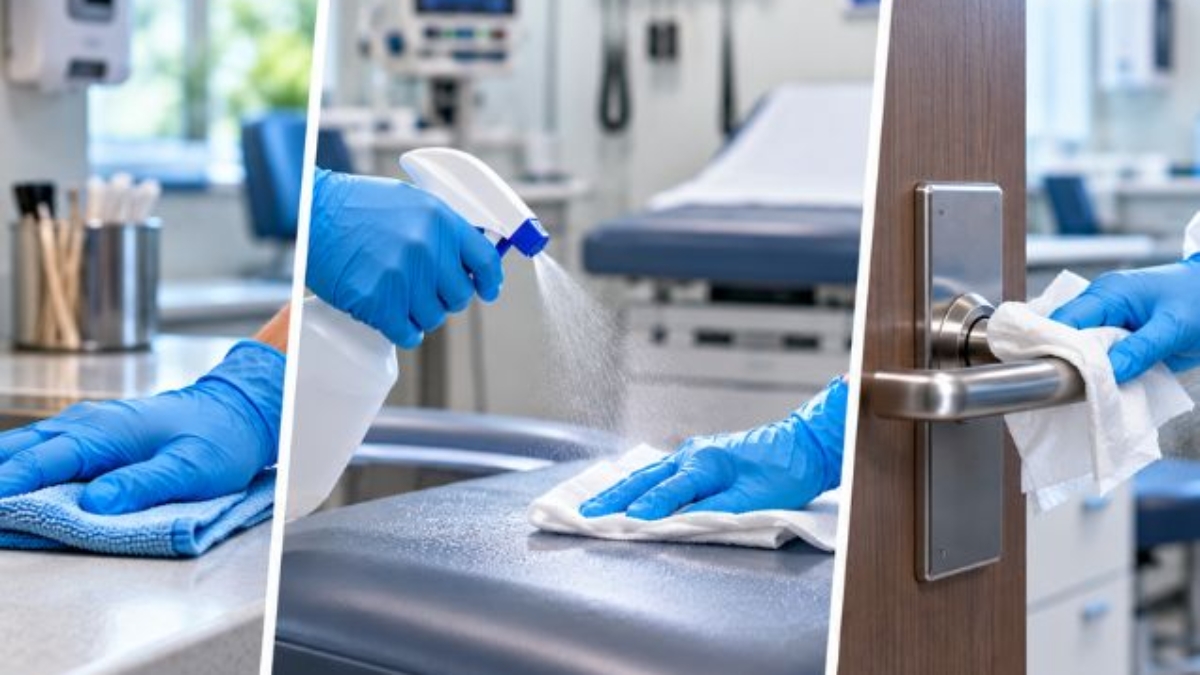
A medical office can look spotless and still have harmful germs on frequently touched surfaces. A shiny reception desk, clean examination table, or freshly mopped floor does not automatically mean the environment meets healthcare cleaning standards.
That’s because cleaning, sanitizing, and disinfecting are three different processes, each serving a specific purpose.
For healthcare facilities, understanding these differences is essential for maintaining a safer environment for patients, healthcare professionals, and visitors.
Professional medical office cleaning services in Knoxville can support healthcare facilities by following appropriate environmental cleaning procedures, selecting suitable products, and focusing on areas that require special attention.
But which process should medical offices use? When is disinfecting necessary? And why isn’t ordinary cleaning always enough?
This guide explains the differences, highlights common mistakes, and explores practical cleaning procedures based on guidance from the Centers for Disease Control and Prevention (CDC) and the Environmental Protection Agency (EPA).
Cleaning vs. Sanitizing vs. Disinfecting: 9 Essential Things Medical Offices Should Understand
Learn 9 essential differences between cleaning, sanitizing, and disinfecting in medical offices, including CDC guidelines, infection prevention, and safe cleaning practices.
1. What Is Cleaning in a Medical Office?
Cleaning means removing visible dirt, dust, organic material, and many germs from surfaces using water, detergents, and physical action.
It does not necessarily kill microorganisms. Instead, cleaning helps remove contamination and prepares surfaces for additional treatment when necessary.
According to the CDC’s environmental cleaning guidance, healthcare facilities should follow structured cleaning procedures based on the risk associated with different patient-care areas.
Common medical office cleaning tasks include:
- Removing dust and debris from furniture.
- Cleaning examination tables and countertops.
- Wiping door handles and reception counters.
- Mopping floors with appropriate cleaning products.
- Cleaning sinks and restroom fixtures.
- Removing waste according to facility procedures.
For example, imagine a patient spills coffee on a waiting room table.
Cleaning removes the coffee and visible residue. However, if the surface also requires disinfection, staff must complete that additional step.
A surface can look clean without being adequately disinfected.
This is why healthcare facilities need procedures that go beyond appearances.
2. What Does Sanitizing Mean in Healthcare Settings?
Sanitizing reduces microorganisms on surfaces to levels considered safe under applicable public health standards.
Unlike ordinary cleaning, sanitizing uses a process or product intended to reduce microbial contamination.
However, sanitizing does not necessarily provide the level of microbial control required for patient-care surfaces.
The EPA distinguishes sanitizers from disinfectants based on their intended purposes and tested antimicrobial claims.
Sanitizing may be appropriate for:
- Certain nonclinical surfaces.
- Food-contact surfaces when using approved products.
- Specific areas where facility procedures call for sanitization.
Healthcare settings require additional caution because patients may have weakened immune systems, open wounds, or other vulnerabilities.
For this reason, sanitizing alone should not replace required disinfection of clinical environmental surfaces.
Providers offering commercial cleaning services in Knoxville should understand these differences before developing cleaning plans for medical facilities.
A product labeled as a sanitizer should not automatically be treated as a healthcare disinfectant.
3. What Is Disinfecting, and Why Does It Matter?
Disinfecting involves using an appropriate chemical product or validated process to destroy or inactivate specified microorganisms on inanimate surfaces.
Disinfection plays an important role in reducing environmental contamination in healthcare settings.
However, disinfectants do not necessarily eliminate every type of microorganism, including bacterial spores.
The CDC recommends using appropriate EPA-registered hospital disinfectants for relevant healthcare environmental surfaces.
Common areas that may require disinfection include:
- Examination tables.
- Patient-care countertops.
- Frequently touched door handles.
- Light switches.
- Treatment-area surfaces.
- Shared equipment surfaces, following manufacturer instructions.
A crucial detail is the product’s contact time.
Contact time refers to how long a disinfectant must remain on a surface under the conditions specified on its label.
If a product requires several minutes of wet contact time, wiping it dry immediately may prevent it from working as intended.
Disinfectant labels are instructions, not decoration.
Healthcare cleaning teams must follow product directions, including dilution, application, surface compatibility, and required contact time.
4. Cleaning vs. Sanitizing vs. Disinfecting: Key Differences
Although people often use these terms interchangeably, their purposes are different.
| Process | Main purpose | Typical healthcare application |
| Cleaning | Removes dirt, organic material, and many germs | Routine surface and floor cleaning |
| Sanitizing | Reduces microorganisms to specified levels | Selected nonclinical or food-contact surfaces |
| Disinfecting | Inactivates specified microorganisms | Clinical and frequently touched environmental surfaces |
The correct process depends on the surface, contamination risk, and facility requirements.
For example, cleaning an administrative office floor may involve routine detergent-based procedures.
An examination table between patients generally requires cleaning and disinfection according to the facility’s infection prevention policy and the product instructions.
Specialized environments also need additional attention.
Facilities considering dialysis center cleaning services in Knoxville should prioritize providers who understand the specific environmental disinfection requirements associated with dialysis treatment areas.
The objective is not to apply the strongest chemical everywhere. It is to use the correct procedure for each surface and situation.
5. Why High-Touch Surfaces Need Special Attention
Not every surface in a medical office carries the same contamination risk.
A storage cabinet that employees rarely touch has different cleaning needs from a door handle that patients and staff use throughout the day.
High-touch surfaces deserve additional attention because frequent contact creates opportunities for microorganisms to spread.
The CDC identifies commonly touched objects as important considerations when developing environmental cleaning schedules.
Medical offices should regularly assess:
- Reception counters and check-in areas.
- Door handles and light switches.
- Examination tables and patient chairs.
- Sink faucets and restroom fixtures.
- Shared keyboards and equipment controls.
- Wheelchair handles and other patient-contact surfaces.
Cleaning frequency should reflect patient activity, contamination risks, and facility policies.
Professional medical office cleaning services in Knoxville can help facilities organize these tasks through documented schedules and clearly assigned responsibilities.
However, environmental cleaning works alongside hand hygiene, safe clinical practices, and other infection prevention measures. It cannot replace them.
6. Why Dialysis Centers Require Specialized Cleaning Procedures
Dialysis facilities present unique environmental cleaning challenges.
Patients receiving dialysis may have increased vulnerability to infections, and treatment areas can encounter blood or other bodily fluids.
That makes consistent environmental cleaning especially important.
The CDC classifies hemodialysis stations as high-risk areas and recommends cleaning and disinfecting patient-zone surfaces between treatments.
Its guidance includes dialysis chairs, countertops, external machine surfaces, and floors within the patient zone.
Important dialysis cleaning considerations include:
- Cleaning and disinfecting stations after each treatment.
- Following the required disinfectant contact time.
- Handling blood or bodily fluid contamination according to facility protocols.
- Separating clean supplies from contaminated materials.
- Cleaning shared high-touch surfaces.
- Completing end-of-day environmental cleaning.
Facilities evaluating dialysis center cleaning services in Knoxville should confirm that providers understand these requirements and can coordinate responsibilities with clinical staff.
A cleaning contractor should never assume responsibility for internal dialysis equipment reprocessing without appropriate authorization, training, and procedures.
Medical equipment maintenance and specialized reprocessing require separate manufacturer-specific protocols.
The goal is to support the facility’s infection prevention program, not replace clinical oversight.
Interesting Read: How Specialty Cleaning Protects Dialysis Patients from Infections
7. Common Medical Office Cleaning Mistakes to Avoid
Even experienced cleaning teams can make mistakes when procedures lack consistency.
Fortunately, many common problems have straightforward solutions.
Mistake 1: Disinfecting visibly dirty surfaces without proper cleaning
Organic material can interfere with disinfectant effectiveness.
Solution: Follow the product label. Remove visible soil before disinfection unless an approved one-step product and its instructions permit otherwise.
Mistake 2: Ignoring disinfectant contact time
Quickly wiping a surface may not provide enough time for the disinfectant to work.
Solution: Keep surfaces wet for the required label contact time.
Mistake 3: Using the same cloth across multiple areas
Reusing contaminated materials can transfer microorganisms between surfaces.
Solution: Follow facility-approved cloth replacement and cleaning procedures.
Mistake 4: Using inappropriate chemicals
Not every cleaning product suits medical environments or sensitive equipment.
Solution: Choose appropriate EPA-registered products and follow manufacturer instructions.
Mistake 5: Forgetting documentation
Without clear records, managers may struggle to confirm whether cleaning tasks occurred.
Solution: Maintain practical cleaning checklists and review staff performance regularly.
Organizations offering commercial cleaning services in Knoxville should adapt their procedures to healthcare environments rather than simply applying ordinary office cleaning routines.
The CDC emphasizes staff training, standardized protocols, and monitoring as important elements of effective healthcare environmental cleaning programs.
8. How Often Should Medical Offices Clean and Disinfect?
Medical offices should establish cleaning schedules based on the activities and risks associated with each area.
There is no single schedule that fits every healthcare facility.
For example, a busy examination room may require cleaning and disinfection between patients, while administrative spaces may need routine daily cleaning.
Consider this general planning framework:
| Medical office area | Cleaning considerations |
| Reception area | Regular attention to frequently touched surfaces |
| Examination rooms | Clean and disinfect patient-contact surfaces between patients as required |
| Restrooms | Scheduled cleaning and disinfection, with additional attention when needed |
| Administrative offices | Routine cleaning and prompt spill removal |
| Dialysis stations | Clean and disinfect between treatments and after the final treatment |
| Shared medical equipment | Follow equipment-specific procedures and assigned responsibilities |
Facilities should determine exact frequencies through risk assessments, applicable requirements, and infection prevention policies.
For example, CDC guidance identifies different cleaning requirements for general patient areas, procedure rooms, and hemodialysis stations.
An effective schedule also identifies who performs each task.
When clinical and environmental services teams share responsibilities, written procedures help prevent important surfaces from being overlooked.
9. How to Choose Professional Medical Office Cleaning Services
Choosing a cleaning provider for a healthcare facility requires more consideration than selecting someone who can mop floors and empty trash cans.
Medical environments demand appropriate training, reliable procedures, and attention to contamination risks.
When evaluating medical office cleaning services in Knoxville, facility managers should ask about healthcare cleaning experience, staff training, product selection, and quality control.
Important questions include:
- Does the provider follow documented healthcare cleaning procedures?
- Are employees trained in safe chemical handling?
- Does the team understand EPA disinfectant label requirements?
- Can the provider identify and prioritize high-touch surfaces?
- Are cleaning responsibilities clearly documented?
- How does the company respond to spills or contamination incidents?
- Does the provider maintain checklists and quality inspection procedures?
Facilities seeking dialysis center cleaning services in Knoxville should also discuss coordination with clinical teams and the boundaries between environmental cleaning and medical equipment reprocessing.
A provider’s ability to explain these responsibilities matters more than broad promises about eliminating every germ.
For healthcare managers comparing commercial cleaning services in Knoxville, the most useful approach is to assess the company’s actual procedures against the facility’s infection prevention needs.
A reliable cleaning plan should be practical, documented, and appropriate for the environment.
The Right Cleaning Process Matters
Cleaning removes dirt. Sanitizing reduces germs to a safer level. Disinfecting kills bacteria and viruses on appropriate hard surfaces. Medical offices need all three and they need them in the right order.
For healthcare facilities in East Tennessee, choosing experienced medical office cleaning services can strengthen daily infection-control practices while keeping the space welcoming for patients. Dialysis centers and other higher-risk facilities should look for specialized dialysis center cleaning services that understand clinical workflows. Even general commercial cleaning services should be evaluated carefully before they enter a medical setting.
A clean-looking office is good. A properly cleaned, sanitized, and disinfected office is safer.
Questions to Ask Before Hiring a Cleaning Company
Before signing a contract, ask:
- How do you train staff for healthcare environments?
- Which disinfectants do you use, and are they EPA-registered?
- How do you ensure required contact times?
- How do you handle blood or body-fluid spills?
- What is your process for medical equipment surfaces?
- How do you document completed work?
- Can you clean outside normal patient hours?
- Who handles quality checks and issue reporting?
Clear answers matter more than polished sales language. A reliable provider should explain its process without hesitation.
Frequently Asked Questions About Medical Office Cleaning, Sanitizing, and Disinfecting
1. What is the difference between cleaning and disinfecting?
Cleaning removes dirt and many germs from surfaces. Disinfecting uses appropriate products to inactivate specified microorganisms.
2. Is sanitizing enough for medical offices?
Not always. Clinical environmental surfaces often require disinfection according to facility protocols and healthcare guidelines.
3. Should medical offices disinfect surfaces every day?
Many patient-care surfaces need daily or more frequent disinfection. The appropriate schedule depends on contamination risk and facility procedures.
4. What disinfectants should medical offices use?
Facilities should select appropriate EPA-registered hospital disinfectants and follow label instructions and equipment manufacturer guidance.
5. Why is contact time important during disinfection?
Contact time allows a disinfectant to work as tested. Surfaces must remain wet for the period specified on the product label.
6. Do dialysis centers need specialized cleaning procedures?
Yes. Dialysis stations require specific environmental cleaning and disinfection procedures between treatments and during end-of-day cleaning.
7. Can regular commercial cleaners clean medical offices?
They may provide services if they have suitable training, procedures, products, and clearly defined responsibilities for the healthcare environment.
